
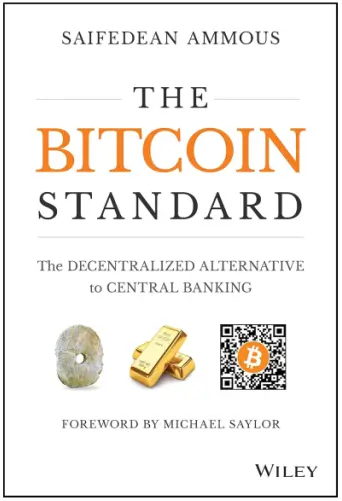
The Bitcoin Standard
The Decentralized Alternative to Central Banking
Saifedean Ammous (2018)
Sinclair Overview
The Bitcoin Standard is a monetary history and economic argument that positions Bitcoin not as a speculative technology, but as a new monetary standard rooted in absolute scarcity. Saifedean Ammous argues that most social, economic, and cultural instability in the modern world stems from unsound money—specifically, money that can be expanded at will by political authorities.
The book’s central claim is that Bitcoin is the first form of money in history that combines:
- Digital portability
- Decentralized settlement
- Credible, programmatic scarcity
In doing so, it restores the key properties that made gold successful as money—while eliminating the weaknesses that allowed gold to be captured, centralized, and ultimately abandoned.
1. The Core Thesis: Money Shapes Civilization
1.1 Money Is Not Neutral
Ammous begins with a foundational assertion:
Money is not just a medium of exchange; it is the foundation of time preference, capital accumulation, and social order.
The quality of a society’s money determines:
- Whether people save or consume
- Whether capital compounds or is depleted
- Whether planning is long-term or short-term
- Whether culture emphasizes production or immediacy
Sound money lowers time preference. Unsound money raises it.
1.2 Monetary Standards Precede Political Outcomes
Echoing (and complementing) The Sovereign Individual, the book argues that political arrangements are downstream of monetary systems.
When money is:
- Hard → societies save, invest, and build
- Easy → societies borrow, inflate, and decay
Politics responds to monetary incentives; it does not override them.
2. A Monetary History of the World
2.1 What Makes Good Money
Ammous frames monetary competition around key properties:
- Scarcity
- Durability
- Divisibility
- Portability
- Salability across time
Across history, societies gravitated toward the money that best preserved value.
2.2 Gold as the Apex of Pre-Modern Money
Gold won not by decree, but by market selection:
- High stock-to-flow ratio
- Costly to produce
- Resistant to debasement
Gold enabled:
- Long-term capital formation
- Global trade
- Civilizational projects spanning generations
However, gold’s success contained a fatal flaw.
3. The Failure of Gold and the Rise of Fiat
3.1 Custody Defeated Scarcity
Gold failed not because it was unsound, but because:
- It required centralized custody for scale
- Custodians became points of control
- Governments captured gold through banks
Once gold was abstracted into paper claims, scarcity was compromised.
3.2 Fiat Money as a Political Instrument
Fiat currency allowed states to:
- Finance wars without taxation
- Expand welfare without savings
- Mask redistribution through inflation
Inflation becomes a hidden tax, disproportionately harming savers and wage earners.
This mirrors The Tower of Basel: monetary control shifts from nations to central banking networks insulated from accountability.
4. Bitcoin: The First Truly Hard Digital Money
4.1 Absolute Scarcity as a Technological Breakthrough
Bitcoin introduces a property no prior money achieved:
A fixed, verifiable, non-negotiable supply schedule.
Key attributes:
- 21 million hard cap
- Predictable issuance
- No authority can alter the rules
- Enforcement through decentralized consensus
Scarcity is no longer social or political. It is computational.
4.2 Settlement Without Custodians
Bitcoin’s most radical feature is not its price or speed, but its settlement model:
- No central clearinghouse
- No discretionary finality
- No trusted intermediary
- No settlement privilege
This directly addresses the historical failures outlined in The Tower of Basel.
5. Bitcoin as a Monetary Standard, Not a Payment App
5.1 Store of Value First, Medium of Exchange Later
Ammous emphasizes:
- Monetary adoption begins with saving, not spending
- Liquidity follows credibility
- Volatility declines as stock-to-flow rises
Bitcoin’s role is to anchor value, not replace Visa.
5.2 Time Preference and Civilization
Sound money:
- Encourages deferred gratification
- Rewards productivity
- Penalizes waste and leverage
Ammous argues that fiat systems incentivize:
- Debt-financed consumption
- Cultural decay
- Asset bubbles over real growth
Bitcoin reverses these incentives.
6. The State, Banking, and Bitcoin
6.1 Why Bitcoin Is Not a Threat — but a Constraint
Bitcoin does not abolish states.
It constrains them.
- It limits monetary debasement
- It introduces competition into money
- It restores exit as a disciplining mechanism
This aligns directly with The Sovereign Individual’s jurisdictional arbitrage thesis.
6.2 Why States Will Resist but Cannot Ban It Globally
Ammous argues:
- Bitcoin is information
- Networks route around control
- Bans push activity elsewhere
States can regulate interfaces, but not the protocol itself.
Resistance is expected — and revealing.
7. Bitcoin in the Context of History
7.1 Bitcoin vs Gold vs Fiat
Bitcoin combines:
- Gold’s scarcity
- Fiat’s portability
- A settlement layer immune to capture
Where gold failed due to custody, Bitcoin eliminates custody risk through self-sovereign ownership.
7.2 Monetary Neutrality Restored
Bitcoin does not allocate credit.
It does not pick winners.
It does not bail out failures.
It restores money as a neutral measuring stick — not a policy tool.
Closing Reflection
The Bitcoin Standard is not primarily a book about Bitcoin.
It is a book about what money must be to support a stable, productive civilization.
Read alongside:
- The Sovereign Individual (why monetary exit becomes necessary)
- The Tower of Basel (why custodial money cannot be trusted)
Bitcoin appears not as an accident, but as an inevitable response to a century of monetary centralization.